The $5,000 Web Accessibility Tax Credit: A Small Business Guide
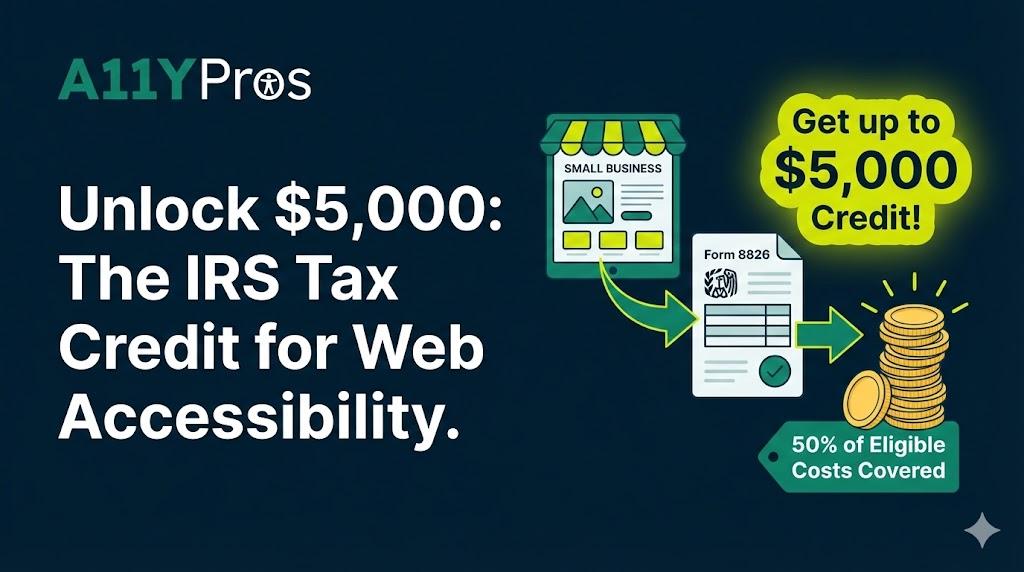
As a small business owner, you know that making your website accessible to everyone—including the 61 million Americans living with a disability—is the right thing to do. It opens your doors to a massive market and protects you from increasing ADA-related legal risks.
But we also know that for a growing business, budget is always top of mind.
What if the IRS picked up 50% of the tab for your web accessibility audit and remediation?
Through IRS Form 8826, many small businesses can claim the Disabled Access Credit, a tax credit specifically designed to help you cover the costs of making your business accessible. Here is how it works and how you can use it to upgrade your digital presence this year.
What is the Disabled Access Credit (Form 8826)?
The Disabled Access Credit is part of the General Business Credit. It was created to help small businesses cover “eligible access expenditures” required to comply with the Americans with Disabilities Act (ADA).
While many people think this only applies to physical ramps or elevators, the IRS definition includes “removing barriers,” “providing auxiliary aids,” and “acquiring or modifying equipment or devices.” In the digital age, this directly applies to making your website accessible to users with visual, auditory, or motor impairments.
Does Your Business Qualify?
The IRS defines a “qualified small business” as one that meets one of the following two criteria from the previous tax year:
- Total revenues of $1,000,000 or less, OR
- Fewer than 30 full-time employees.
If you fit either of those descriptions, you are eligible to claim the credit.
How Much is the Credit Worth?
This isn’t just a “deduction” (which only reduces your taxable income); it’s a credit, which reduces your actual tax bill dollar-for-dollar.
The credit is calculated as 50% of eligible expenditures between $250 and $10,250.
- The first $250 is not covered.
- The maximum expenditure eligible for the credit is $10,250.
- The maximum annual credit is $5,000.
The Math in Action:
If you hire an accessibility consultant for a $5,000 project to audit and fix your website:
- Total Cost: $5,000
- Subtract the $250 threshold: $4,750
- 50% Tax Credit: $2,375
- Your effective cost for the project: $2,625
By using the tax credit, you’ve essentially secured a 47% discount on your accessibility compliance.
What Web Services Are Covered?
Under the umbrella of “providing auxiliary aids and services,” the following web accessibility efforts typically qualify:
- Accessibility Audits: Professional reviews of your site’s code and design.
- Remediation: Fixing your website’s code to meet WCAG 2.1/2.2 standards.
- PDF Remediation Services: Ensuring your digital documents, brochures, and manuals are fully tagged and readable by assistive technologies.
How to Claim the ADA Tax Credit
Claiming the ADA tax credit requires proper documentation and adherence to IRS guidelines. Here’s a step-by-step approach:
- Document Your Accessibility Expenses
Keep detailed records of all website accessibility improvements, including invoices, contracts, and receipts. Ensure that each expense is directly related to accessibility compliance. - Complete IRS Form 8826
To claim the credit, you must fill out IRS Form 8826, which is specifically designed for the Disabled Access Credit. The form requires:- Business details
- Total accessibility-related expenditures
- Calculation of the credit amount
- Include the Credit in Your Tax Filing
Once you’ve completed Form 8826, submit it with your business tax return. If you`re unsure how to apply the credit, consult a tax professional to ensure proper filing.
Why You Should Act Now
Tax incentives aside, web accessibility is becoming a “must-have” for three major reasons:
- Market Reach: People with disabilities have a combined disposable income of nearly $500 billion. If they can’t use your site, they can’t buy from you.
- SEO Benefits: Many accessibility best practices (like clean headers and alt-text) are also SEO best practices that help you rank higher on Google.
- Legal Protection: ADA title III lawsuits regarding website accessibility have skyrocketed. The cost of a proactive audit is significantly lower than the cost of a legal settlement.
Get Started Today
Don’t let the cost of compliance hold your business back. By leveraging the Disabled Access Credit, you can build a more inclusive, high-performing website for a fraction of the price.
Ready to make your website accessible? Contact us for a free consultation. We’ll help you identify the barriers on your site and provide the documentation you need to help your CPA file Form 8826.
Disclaimer: While we are experts in web accessibility, we are not tax professionals. You should always consult with your CPA or tax advisor to ensure your business qualifies for the Disabled Access Credit.
Achieve Digital Accessibility Compliance
Explore our manual WCAG 2.1/2.2 AA auditing, website remediation, PDF compliance, and VPAT® documentation services.